

Aerostructures Market Expected to Reach $90.31 Billion by 2030 Driven by Robust Industry Expansion
aerostructures_global_market_report_Comp_And_Segment.webp
aerostructures_global_market_report_Regions_And_Drivers.webp
aerostructures_global_market_report_All_Infos.webp
The Business Research Company's Aerostructures Market Report 2026 – Market Size, Trends, And Global Forecast 2026-2035
LONDON, GREATER LONDON, UNITED KINGDOM, October 12, 2026 /EINPresswire.com/ -- "The aerostructures segment is a pivotal part of the aerospace industry, playing a crucial role in shaping the future of aircraft manufacturing. As demand for more efficient, lightweight, and durable aircraft grows, this market is set to experience notable expansion. The following provides a detailed overview of the market size, growth drivers, leading companies, and emerging trends shaping the aerostructures domain.
Projected Market Size and Growth of the Aerostructures Market by 2030
The aerostructures market is anticipated to surpass $90 billion by 2030. Its parent sector, Commercial Aircraft, is forecasted to reach nearly $272 billion within the same timeframe, with aerostructures capturing about one-third of that value. Within the broader Aerospace & Defense industry, expected to hit $1,166 billion by 2030, aerostructures will constitute close to 8% of the total market. Key highlights include a 7% compound annual growth rate (CAGR) leading up to 2030, North America emerging as the largest regional market, and Airbus S.A.S. holding the top spot in 2025 with a 9% market share. The top 10 companies collectively accounted for 22% of the market in 2025.
Request A Free Sample Of The Aerostructures Market Report
https://thebusinessresearchcompany.com/sample_request?id=61808875&type=smp&name=Aerostructures%20Market%20Report%202026&utm_source=EINPresswire&utm_medium=Paid&utm_campaign=Oct_PR
Major Factors Fueling Growth in the Aerostructures Market
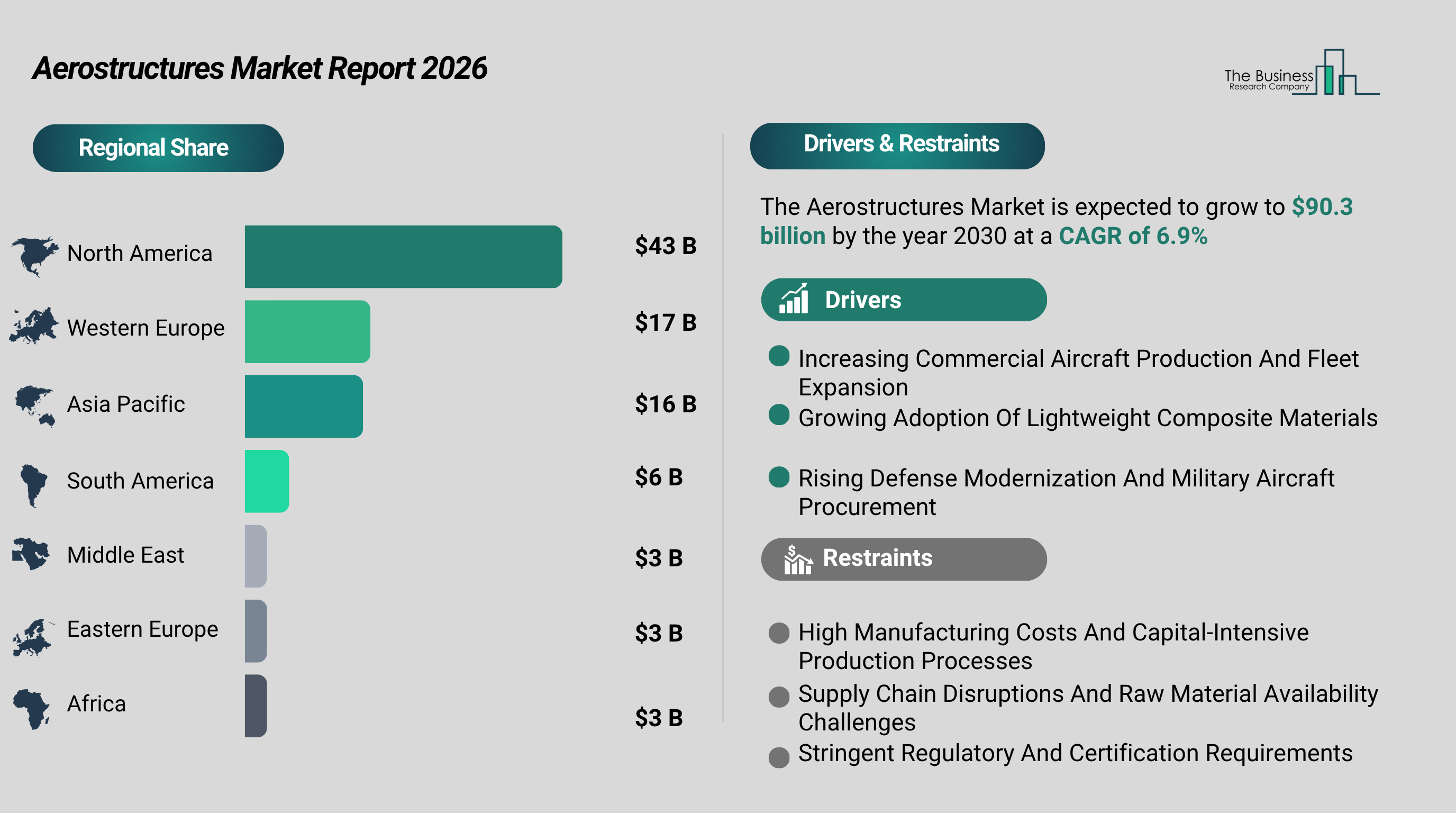
One significant driver behind the aerostructures market’s rapid expansion is the increase in commercial aircraft production and fleet enlargement. Rising passenger and cargo transportation demand is prompting manufacturers to boost production rates as airlines phase out older planes. This elevation in output generates steady demand for various structural components like fuselages, wings, empennages, nacelles, pylons, and flight control surfaces, contributing approximately 2.2% annual market growth.
Another strong influence supporting market growth is the broader use of lightweight composite materials. Aircraft manufacturers are increasingly incorporating carbon fiber composites, titanium alloys, and advanced aluminum in their designs. These materials help reduce structural weight while enhancing strength, durability, and corrosion resistance, which improves fuel economy, flight range, and environmental compliance. This trend is expected to add about 2% growth per year to the aerostructures market.
Access The Detailed Aerostructures Market Report Here
https://thebusinessresearchcompany.com/report/aerostructures-global-market-report?utm_source=EINPresswire&utm_medium=Paid&utm_campaign=Oct_PR
The third major growth catalyst is heightened defense modernization and military aircraft procurement efforts. Governments worldwide are investing heavily in advanced fighter jets, transport aircraft, helicopters, surveillance systems, aerial refueling platforms, and unmanned aerial vehicles, along with upgrades to existing fleets and domestic aircraft development programs. These activities are projected to contribute around 1.7% annual growth by increasing demand for high-performance structural assemblies and precision manufacturing.
Leading Market Segment by Component in Aerostructures
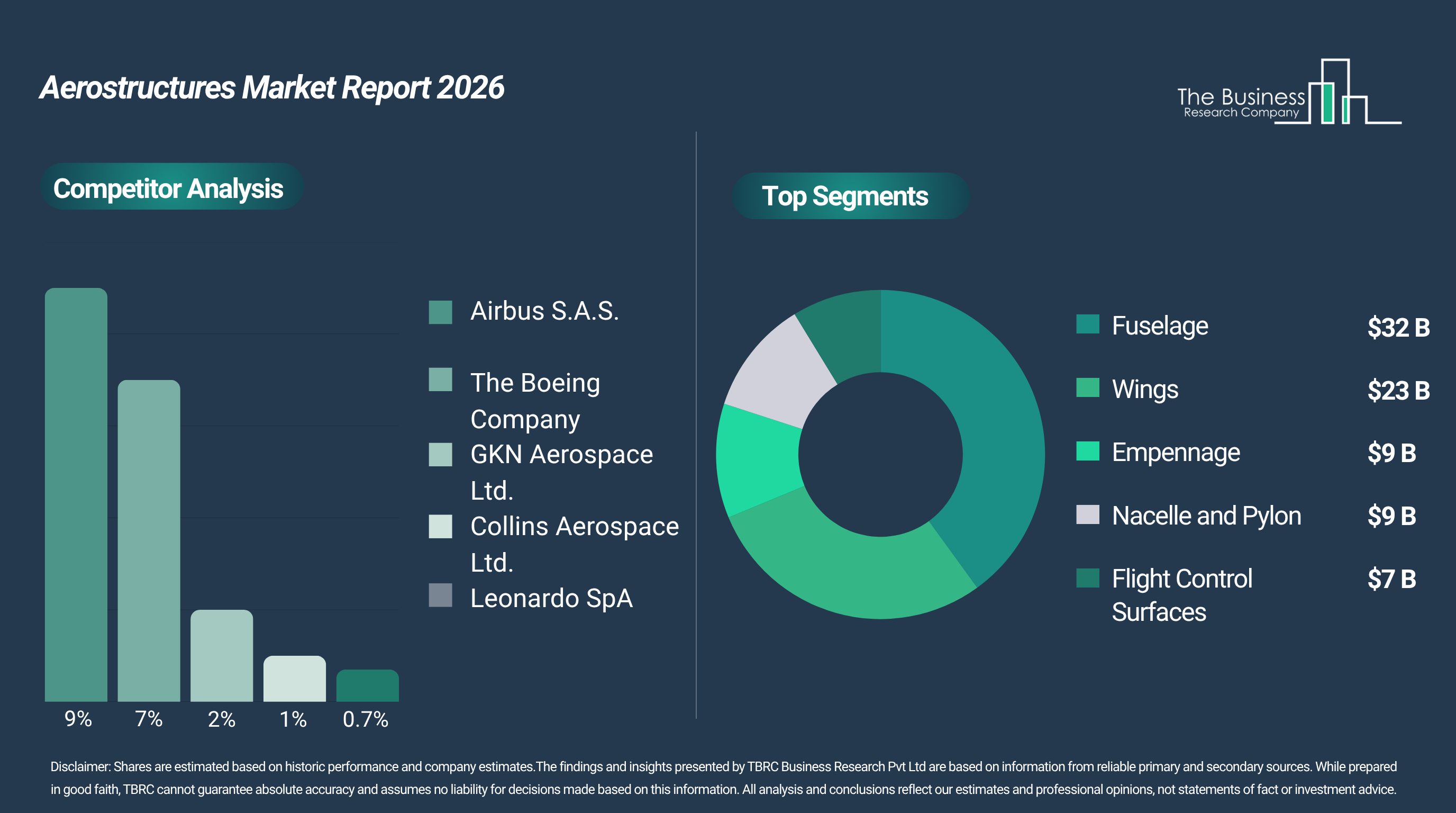
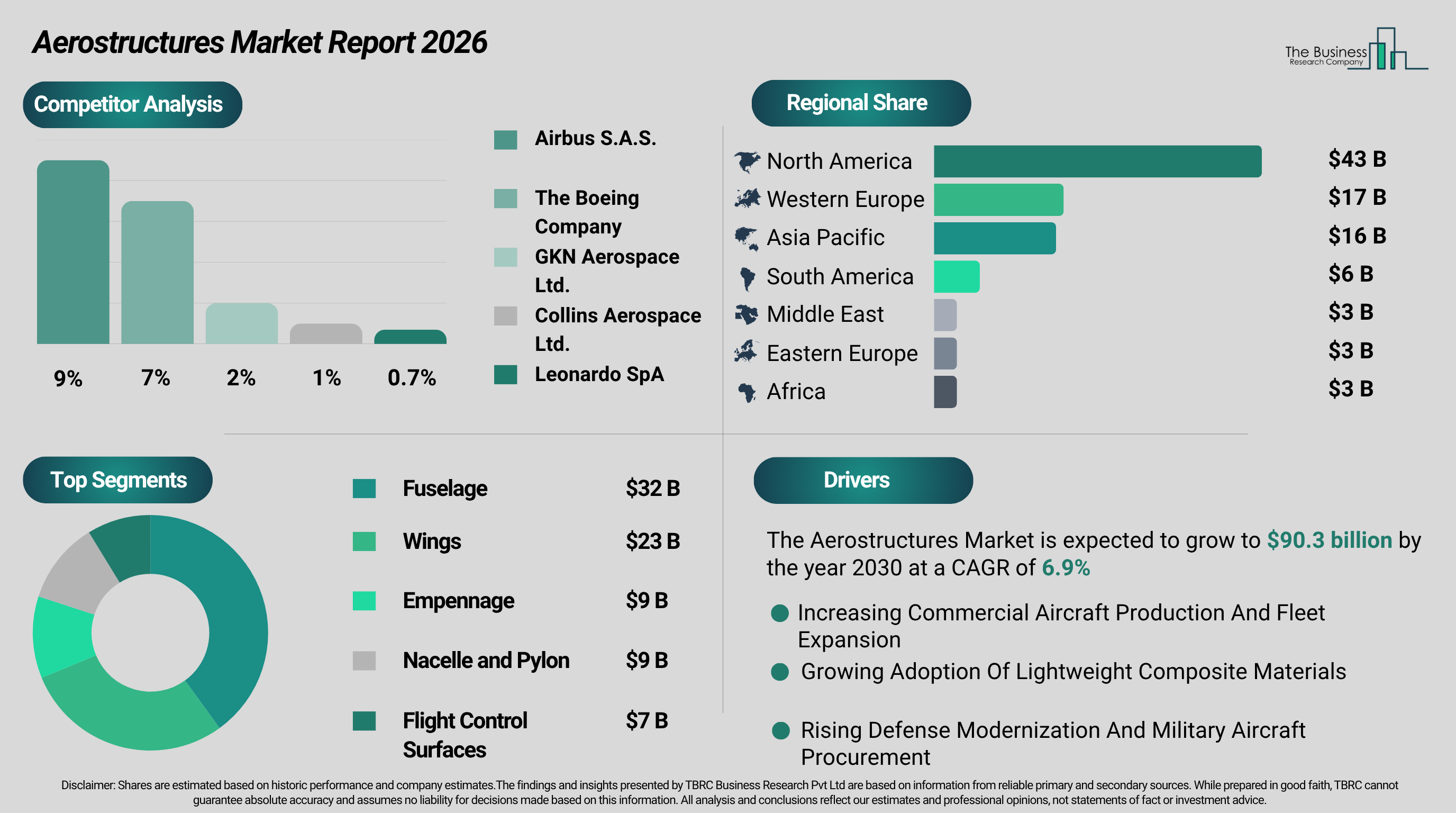
The aerostructures market is categorized by components such as fuselage, empennage, flight control surfaces, wings, nose, nacelle and pylon, as well as doors and skid. Among these, the fuselage segment is set to dominate in 2030, representing 35% of the market or roughly $32 billion. This leadership is driven by the rising demand for lightweight composite fuselage designs, increased production of narrow-body and wide-body aircraft, modular manufacturing processes that enhance efficiency, and advancements in structural engineering that improve durability, safety, and aerodynamic performance.
Additional Aerostructures Market Divisions by Material, Platform, and End Use
Further segmentation includes dividing the market by materials into composites, alloys and superalloys, and metals. Platform-wise, the market serves fixed-wing aircraft, rotary-wing aircraft, unmanned aerial vehicles (UAVs), and advanced air mobility solutions. End-use segments encompass original equipment manufacturers (OEMs) and aftermarket supply chains.
North America as the Dominant Region in Aerostructures
North America is projected to remain the largest regional market for aerostructures by 2030, with a valuation of $43 billion, up from $30 billion in 2025, reflecting a 7% CAGR. This robust market growth is attributed to increased commercial aircraft production for fleet expansions, strong defense spending on next-generation aircraft, investments in cutting-edge aerospace manufacturing, and the growing adoption of lightweight structural designs that enhance fuel efficiency and overall aircraft performance.
United States Leading Country Outlook in Aerostructures
Within the global context, the United States is expected to be the biggest country market in aerostructures by 2030, reaching $37 billion from $26 billion in 2025, maintaining the same 7% CAGR. Expansion is supported by military aviation modernization initiatives, rising demand for fuel-efficient commercial jets, increasing output from domestic aerospace manufacturers, and advancements in precision manufacturing and automated aircraft assembly.
Competitive Landscape and Industry Players in the Aerostructures Sector
The aerostructures market features a blend of global aerospace giants, component suppliers, and specialized technology providers. These companies invest heavily in lightweight composite structures, precision manufacturing, and expanding production capabilities. Competitive success depends on innovations that improve fuel efficiency, reduce weight, enhance structural resilience, optimize supply chains, and leverage advanced materials. Understanding this competitive terrain enables stakeholders to spot growth avenues, foster technological innovation, and pursue collaborations within commercial aviation and aerospace manufacturing.
Market Leadership and Company Shares in Aerostructures
In 2025, Airbus S.A.S. led the market with a 9% share from its aerostructures division, which delivers a wide range of components including wings, fuselage sections, empennages, and composites, catering to commercial, defense, and next-generation aerospace programs. The market remains moderately fragmented, with the top 10 firms holding 22% of total revenues. This reflects the balance between high entry barriers such as stringent quality standards, advanced material requirements, certification processes, and the need for reliable precision manufacturing. Leading companies maintain their positions through diversified product portfolios, global manufacturing networks, OEM partnerships, and continuous innovation in lightweight materials and production techniques.
Key market shares of leading companies in 2025 include: Airbus S.A.S. at 9%, The Boeing Company at 7%, GKN Aerospace Ltd. at 2%, with Collins Aerospace Ltd., Leonardo SpA, Mitsubishi Heavy Industries Ltd. each holding about 1%, and Kawasaki Heavy Industries Ltd., FACC AG, BAE Systems plc, and Lockheed Martin Corporation each with smaller shares around 0.1% to 0.2%.
New Technological Advances Influencing the Aerostructures Market
The rise of advanced composite airframes is transforming the aerostructures market by significantly reducing aircraft weight while boosting fuel efficiency and structural integrity for future aircraft generations. For example, in August 2025, Vertical Aerospace Ltd. partnered with Aciturri Aerostructures S.A. to develop the complete airframe for its VX4 electric vertical takeoff and landing (eVTOL) aircraft. This design incorporates lightweight composites, aerodynamic efficiency, and electric propulsion integration, which together enhance durability, enable scalable production, and lower emissions, noise, and operational costs.
Segments Offering Prime Growth Potential Within Aerostructures
Components such as fuselage, wings, empennage, nacelle and pylon, flight control surfaces, doors and skid, and nose present the most promising growth prospects. These segments are forecasted to collectively add over $26 billion in market value between 2025 and 2030. The fuselage segment alone is expected to grow by $9 billion, followed by wings adding $6 billion, empennage $3 billion, nacelle and pylon $3 billion, flight control surfaces $2 billion, doors and skid $2 billion, and nose $1 billion. Growth drivers include advancements in automated composite manufacturing, increasing demand for fuel-efficient aircraft structures, investments in modern aerospace production facilities, and innovations in lightweight design that enhance performance and lifecycle efficiency.
Strategic Focus Areas for Companies in Aerostructures
Leading firms are concentrating on several priorities to maintain competitiveness: improving lightweight aerostructure technologies to boost efficiency and sustainability; employing advanced composite materials to enhance strength and reduce weight; scaling up aircraft production capabilities to meet commercial and military demand; and adopting automated manufacturing processes to achieve higher precision and productivity.
Key Players Driving the Aerostructures Industry
Some of the prominent companies competing in the aerostructures market are Airbus S.A.S., The Boeing Company, GKN Aerospace Ltd., Collins Aerospace Ltd., Leonardo SpA, Mitsubishi Heavy Industries Ltd., Kawasaki Heavy Industries Ltd., FACC AG, BAE Systems plc, Bombardier Inc., Lockheed Martin Corporation, Northrop Grumman Corporation, General Dynamics Corporation, Elbit Systems Ltd., Safran S.A., Singapore Technologies Engineering Ltd., Dassault Aviation S.A., RTX Corporation, Saab AB, Embraer S.A., Aero Vodochody AEROSPACE a.s., and Belge de Constructions Aéronautiques SA.
Understanding the Aerostructures Market Ecosystem
The ecosystem comprises raw material suppliers such as Hexcel Corporation, Toray Industries, Inc., Solvay S.A., Teijin Limited, Mitsubishi Chemical Group Corporation, and others specializing in advanced composites and metals. Wholesalers and distributors include companies like Wesco International, Avnet, Arrow Electronics, Digi-Key Electronics, and RS Group, who facilitate supply chain management. End users span major aerospace manufacturers and defense contractors including The Boeing Company, Airbus SE, Lockheed Martin Corporation, Northrop Grumman Corporation, General Dynamics Corporation, BAE Systems plc, Leonardo S.p.A., Embraer S.A., Textron Inc., Saab AB, Dassault Aviation SA, Gulfstream Aerospace Corporation, Spirit AeroSystems Holdings, and others.
This broad network supports the complex demands of aerostructures production, ensuring availability of cutting-edge materials, components, and finished products for the evolving aerospace and defense markets.
New additions to our 2026 reports:
• Market attractiveness scoring and analysis
• Total addressable market (TAM) analysis
• Company scoring matrix graphics and tables
• Excel-based forecasting dashboards
• Market hotspots infographics
• Key technologies and future trend analysis
• Updated graphics and tables
Learn More About The Business Research Company
The Business Research Company (www.thebusinessresearchcompany.com) is a leading market intelligence firm renowned for its expertise in company, market, and consumer research. We have published over 30,000+ reports across 27 industries and 60+ geographies. Our research is powered by 1,500,000 datasets, extensive secondary research, and exclusive insights from interviews with industry leaders.
We provide continuous and custom research services, offering a range of specialized packages tailored to your needs, including Market Entry Research Package, Competitor Tracking Package, Supplier & Distributor Package and much more.
Disclaimer: Please note that the findings, conclusions and recommendations that TBRC Business Research Pvt Ltd delivers are based on information gathered in good faith from both primary and secondary sources, whose accuracy we are not always in a position to guarantee. As such TBRC Business Research Pvt Ltd can accept no liability whatever for actions taken based on any information that may subsequently prove to be incorrect. Analysis and findings included in TBRC reports and presentations are our estimates, opinions and are not intended as statements of fact or investment guidance.
Contact Us:
The Business Research Company
Americas +1 310-496-7795
Europe +44 7882 955267
Asia & Others +44 7882 955267 & +91 8897263534
Email: marketing@tbrc.info
Follow Us On:
LinkedIn: https://in.linkedin.com/company/the-business-research-company"
Oliver Guirdham
The Business Research Company
+44 7882 955267
info@tbrc.info
Visit us on social media:
LinkedIn
Facebook
X
Legal Disclaimer:
EIN Presswire provides this news content "as is" without warranty of any kind. We do not accept any responsibility or liability for the accuracy, content, images, videos, licenses, completeness, legality, or reliability of the information contained in this article. If you have any complaints or copyright issues related to this article, kindly contact the author above.
