

Cloud Security Market to Reach US$ 186.1 Billion by 2033 at 17.5% CAGR, Trends & Insights
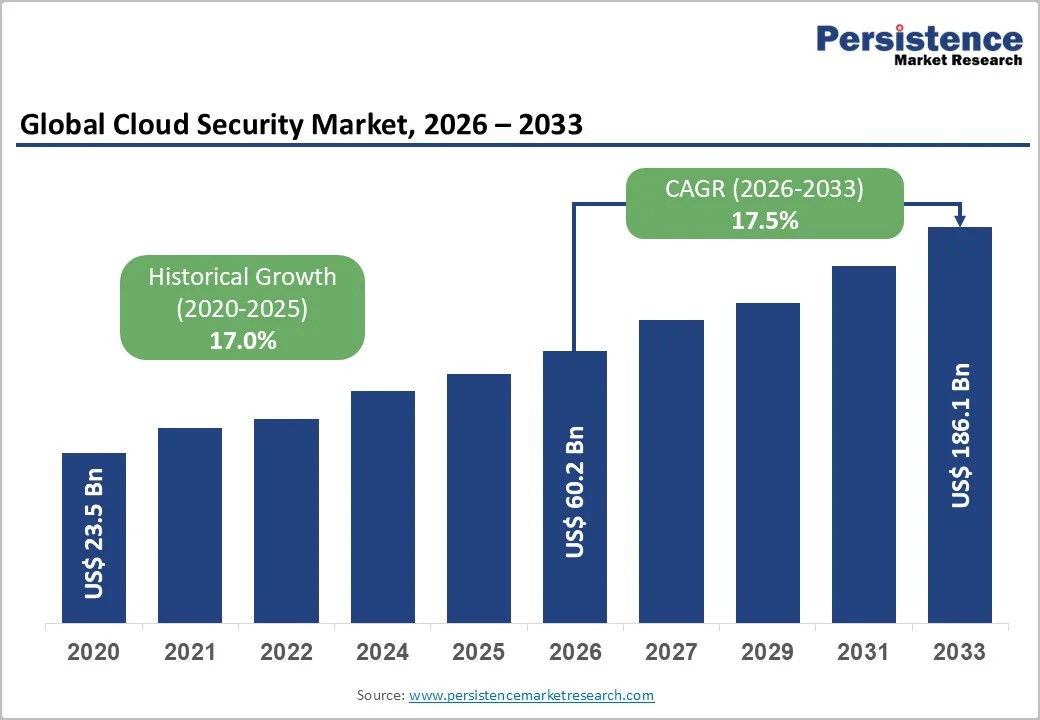
Global cloud security market to grow from US$60.2 billion in 2026 to US$186.1 billion by 2033, registering a 17.5% CAGR.
BRENTFORD, ENGLAND, UNITED KINGDOM, February 4, 2026 /EINPresswire.com/ -- The cloud security market has emerged as a cornerstone of modern digital infrastructure as enterprises increasingly migrate workloads, applications, and sensitive data to cloud environments. Cloud security refers to a broad set of technologies, policies, controls, and services designed to protect cloud-based systems from cyber threats, data breaches, and compliance risks. As organizations adopt public, private, and hybrid cloud models, the need for robust cloud security solutions has shifted from optional to mission-critical.
Globally, the cloud security market size is likely to be valued at US$60.2 billion in 2026 and is expected to reach US$186.1 billion by 2033, expanding at a strong CAGR of 17.5% from 2026 to 2033. This rapid growth is primarily driven by escalating cyberattacks, widespread enterprise cloud adoption, and strict data protection regulations such as GDPR and CCPA. Among solution types, Identity and Access Management (IAM) dominates due to its central role in zero-trust frameworks, while North America leads geographically, supported by advanced cloud infrastructure, high cybersecurity spending, and strong regulatory enforcement.
𝐆𝐞𝐭 𝐚 𝐒𝐚𝐦𝐩𝐥𝐞 𝐏𝐃𝐅 𝐁𝐫𝐨𝐜𝐡𝐮𝐫𝐞 𝐨𝐟 𝐭𝐡𝐞 𝐑𝐞𝐩𝐨𝐫𝐭: https://www.persistencemarketresearch.com/samples/2704
Cloud Security Market Statistics and Competitive Positioning
Cloud security spending continues to rise as organizations face increasingly sophisticated threats such as ransomware, phishing, and insider attacks. The market has maintained a steady historical growth rate of 17.0% CAGR between 2020 and 2025, indicating long-term demand stability. Enterprises are prioritizing proactive threat detection, real-time monitoring, and automated compliance as cloud ecosystems grow more complex.
Large enterprises represent the leading enterprise segment, accounting for over 70% of total revenue, as they operate multi-cloud environments that demand comprehensive protection. From an industry perspective, BFSI remains the leading end-user, contributing nearly 25% of the market share, driven by the need to secure financial transactions, customer data, and digital banking platforms. Regionally, North America is expected to hold around 40% market share in 2026, while Asia Pacific is emerging as the fastest-growing region due to aggressive digital transformation in India and China.
Cloud Security Market Segmentation Analysis
The cloud security market is segmented by security type, including identity and access management, data loss prevention, cloud workload protection, security information and event management (SIEM), and encryption solutions. Among these, IAM holds the largest share as enterprises implement zero-trust architectures to manage user identities, privileges, and access rights across distributed cloud environments. Data loss prevention and workload protection are also gaining traction as organizations seek deeper visibility into cloud-native threats.
Based on end-user and enterprise size, the market is segmented into BFSI, healthcare, IT and telecom, retail, government, and manufacturing, along with SMEs and large enterprises. Large enterprises dominate due to their complex cloud deployments and higher cybersecurity budgets. However, SMEs are increasingly adopting cloud security-as-a-service models, attracted by scalable pricing, automated compliance tools, and managed security services that reduce operational complexity.
Regional Insights: Global Cloud Security Trends
North America continues to dominate the cloud security market, driven by early cloud adoption, advanced cybersecurity infrastructure, and strict regulatory requirements in the United States and Canada. The presence of major cloud service providers and cybersecurity vendors further accelerates innovation and market maturity across the region.
Asia Pacific is witnessing the fastest growth, fueled by rapid digitalization, expanding SME ecosystems, and government-led cloud initiatives in countries such as India, China, and Southeast Asia. Increasing awareness of data protection laws and rising cybercrime incidents are pushing enterprises to invest aggressively in cloud security solutions.
𝐃𝐨 𝐘𝐨𝐮 𝐇𝐚𝐯𝐞 𝐀𝐧𝐲 𝐐𝐮𝐞𝐫𝐲 𝐎𝐫 𝐒𝐩𝐞𝐜𝐢𝐟𝐢𝐜 𝐑𝐞𝐪𝐮𝐢𝐫𝐞𝐦𝐞𝐧𝐭? 𝐑𝐞𝐪𝐮𝐞𝐬𝐭 𝐂𝐮𝐬𝐭𝐨𝐦𝐢𝐳𝐚𝐭𝐢𝐨𝐧 𝐨𝐟 𝐑𝐞𝐩𝐨𝐫𝐭: https://www.persistencemarketresearch.com/request-customization/2704
Market Drivers Shaping the Cloud Security Industry
The primary driver of the cloud security market is the surge in cyber threats targeting cloud-based infrastructure. Ransomware attacks, data breaches, and advanced persistent threats are becoming more frequent and costly, forcing organizations to strengthen their cloud defense strategies. AI-driven threat detection and real-time monitoring are becoming essential components of modern cloud security platforms.
Another major driver is the rapid adoption of multi-cloud and hybrid cloud architectures. As enterprises distribute workloads across multiple cloud providers, securing data visibility, access control, and compliance becomes more complex, driving demand for integrated cloud security solutions that offer centralized management and automation.
Market Restraints Limiting Cloud Security Adoption
Despite strong growth prospects, the cloud security market faces challenges related to integration complexity and skills shortages. Deploying cloud security solutions across diverse cloud environments often requires specialized expertise, which many organizations lack. This skills gap can slow adoption, particularly among smaller enterprises.
Cost concerns also act as a restraint, especially for advanced AI-based security platforms. While cloud security reduces long-term risk exposure, the upfront investment and ongoing subscription costs may deter budget-constrained organizations, limiting penetration in certain developing markets.
Market Opportunities and Future Growth Potential
The growing adoption of zero-trust security models presents a significant opportunity for cloud security vendors. As organizations move away from perimeter-based security, demand for identity-centric solutions, continuous authentication, and behavioral analytics is expected to rise sharply.
Additionally, increasing regulatory scrutiny around data privacy and compliance creates opportunities for automated compliance and governance tools. Cloud security providers that integrate AI, machine learning, and regulatory reporting capabilities are well-positioned to capitalize on long-term market expansion through 2033.
𝐁𝐮𝐲 𝐍𝐨𝐰 𝐭𝐡𝐞 𝐃𝐞𝐭𝐚𝐢𝐥𝐞𝐝 𝐑𝐞𝐩𝐨𝐫𝐭: https://www.persistencemarketresearch.com/checkout/2704
Company Insights: Key Players and Recent Developments
Palo Alto Networks
Cisco Systems, Inc.
IBM Corporation
Microsoft Corporation
Amazon Web Services (AWS)
Google Cloud
Fortinet, Inc.
Check Point Software Technologies
Recent Developments:
Leading cloud security vendors are increasingly integrating generative AI into threat detection platforms to improve response times and reduce false positives. Additionally, several major players have expanded their zero-trust security portfolios through strategic acquisitions and partnerships to strengthen multi-cloud protection capabilities.
Related Reports:
Healthcare Revenue Cycle Management Software Market
Pooja Gawai
Persistence Market Research
+1 646-878-6329
email us here
Visit us on social media:
LinkedIn
Instagram
Facebook
YouTube
Legal Disclaimer:
EIN Presswire provides this news content "as is" without warranty of any kind. We do not accept any responsibility or liability for the accuracy, content, images, videos, licenses, completeness, legality, or reliability of the information contained in this article. If you have any complaints or copyright issues related to this article, kindly contact the author above.
